Friday, November 30, 2018

Weekly Update - November 30, 2018

Happy Friday, everyone!

Tier 2 Behavior Plans:
A month ago, our PBIS team looked at providing tier 2 behavior plans.  These tier 2 behavior plans were for students who needed some extra time and support around behaviors.  I'm hoping these were developed and shared with all teachers (including specialists) who work with the student.  This includes students who are "off task", who "refuse to work", and are "disengaged".

This week, I saw 10 students in the office for "refusal to work".  I understand this can be frustrating as a teacher - believe me, I was in this situation.  My hope is that these students have tier 2 plans developed and that strategies are in place to "re-engage" the student.  I am here to assist in brainstorming those strategies, if you need.

With those that are coming to the office, I will be asking to connect on those plans.  The plan will help us create a very clear process and support(s) to the student - everyone is on the same page about teaching the student the appropriate behavior(s).


Unconscious Biases:
Last year, we did some work around your unconscious biases.  Remember, these are your hidden beliefs that come automatically - you are usually unaware of them.  It is often defined as "quick judgments and assessments of people and situations".  These biases come from your background, cultural environment, and personal experiences.

Since our work, have you come across any additional biases that you weren't aware of?  Have you addressed any biases?  Remember, the TED talk we watched said to walk right toward those biases - get to know people on a different level and "re-train" your brain to see those biases differently.

As educators, we have an ethical obligation to challenge our biases each and every day.   Our biases create our body language, language, and the beliefs about people and students.  This "unconscious bias" can make or break a student's success in our school.

If you haven't been already, continue to challenge your biases - be aware of them or walk toward them!


Engagement Strategy - Quick Draw:
A Quick-Draw is a great way to get students engaged in their learning - building background knowledge, taking a larger concept and making it understood, or just to solidify their learning.  It's a quick (and creative) way to give students time to think, process, and reflect!


McKinleyStrong Theme of the Month:
Our theme of the month is integrity.  

Building Weekly Newsletter:
Click here to access the building weekly newsletter

McKinleyStrong Educator of the Week:
Our McKinleyStrong Educator of the Week goes to 3rd Grade Teacher, Karla Wilke!  Karla is creative, energetic, and focused on each individual student.  Karla builds a learning community where students feel valued and welcomed.  One of the things that impresses me most about Karla is the deep, meaningful relationships that she builds with her students.  She is there to help every student. Keep up the great work, Karla... you are McKinleyStrong!

Friday, November 16, 2018

Weekly Update- November 16, 2018

Happy Friday- and Go Huskies!

Transition Day:
We have a transition day on November 26th.  A huge thank you to our committee - Jess Zupansic, Michelle Simon, Katie Demmer, Libby Zeman, Annette Warner, Amy Wencl, Gabby Wagner, Kayla Davis, and Sam Ladd - for organizing this.

Reminder - you can wear jeans and your STEAM gear on Monday.  Our goal is to rebuild relationships, regulate students, and re-establish routines.

Click here to see the Transition Day options


End of 1st Trimester:
Just a reminder - the end of the first trimester is Friday, November 30 (the week we return from break). 


MTSS Follow Up Meetings on Monday & Tuesday: 

A Note from Libby
It will be great to have a block of time devoted to examining student learning and growth with foundational skills on Monday or Tuesday!  

I will bring a copy of the graph with progress monitoring data for each student who has received an intervention.  Currently, tier 2 and tier 3 teachers are adding notes to those graphs. I will also bring some guidelines that we will use to examine if an intervention is working for a student so that we have a consistent way to figure out next steps for students.

Please bring:*Your computer*Any EU data you have for the next power 20 cycle (assessments and anecdotal)*A list of any additional interventions students are receiving outside of the power 20 (could be with an EA, special education teacher, etc.)*Your current spreadsheet of what students are receiving*Any PRESS data that you have (progress monitoring sheets/data).
I'm looking forward to planning with you next week!


Getting Rid of Some Ineffective Practices:
We've all said it.. including me - "I'm so overwhelmed" or "I've got so much on my plate right now".  This is true - teaching is an extremely hard job. 

I was recently introduced to this article - "5 Common Teaching Practices I'm Kicking to the Curb!".   Take some time to read this - there are things we can get rid of and feel good about getting rid of!  Her list includes:  popcorn/round robin reading, giving students prepared notes, whole class punishments, using learning styles to plan instruction, and having advanced students help struggling students ("differentiating").  The thing I like the most about this article is she provides the "why", but also gives strategies on what to do instead!  


Mindfulness Moment:
#6 of 6 ideas for creating a mindful classroom: 6) Gratitude practice.
The following is an excerpt from: the blog post, The Pause That Refreshes: 6 ideas for creating mindfulness in the classroom, Written by Betsy Caruso, August 16, 2018
Millions of years ago when humans lived in the wild, our brains evolved to be alert to danger. Despite the fact that most of us no longer face the existential threat of wild animal attack, our brain still maintains that ‘early warning system’. We are really expert at remembering the bad stuff but not so hot a recalling the good. Dr. Rick Hanson defines this ‘negativity bias’ as Velcro for negative experiences but Teflon for positive ones. Gratitude practice helps us embody the emotions and sensations associated with positive experience. It can guide us toward equanimity by balancing out our overall perception of what has occurred during a certain period, be it math class, the school day, or a particular event at home.
Gratitude practice is a simple way to share and remind ourselves and others about the things that matter. Sitting in a circle and each sharing something we’re grateful for can be a lovely way to end the day. This practice can be surprisingly informative, and don’t forget to include yourself in the circle.
Challenge: Post in the comments something a student reported to be grateful for.  A winner will be drawn for a prize. - Annette M Warner, LICSW

Building Weekly Newsletter:
Click here to access the building weekly newsletter

McKinleyStrong Educator of the Week:
The McKinleyStrong Educator of the Week goes to Assistant Secretary, Selena Flemming!  On a given day, Selena wears many hats at McKinley - attendance, entering data, greeting families, answering phones, etc.  Selena is a positive, energetic team member who makes every one of our families and students feel welcomed.  Selena makes McKinley a welcoming environment for all.  Keep up the great work, Selena! 


Have a great weekend - sounds like there is snow on the way tonight!
-Justin

Friday, November 9, 2018

Weekly Update - November 9, 2018

Happy Friday!
We just completed another great week of learning & relationships at McKinley!  Keep up the great work! 

Round Robin Reading:
It's been energizing to get around the building and see guided in reading in action.  It has been great to see the concentrated focus on this - and the way you are providing high quality instruction to our readers.   One of the strategies I see is round robin reading - students each, individually, reading aloud at the table to their guided group.  One student reads, everyone else listens.  This strategy has its limitations - mostly around the fact that a student is only reading a small segment of the text during a lesson.  The student isn't apply decoding, fluency, or any other word attack strategies as they aren't engaged with the text like a reader would be.  It was eye opening to me during my LLI training this summer -  when a student is at around level H or higher, they should move from reading aloud to silently reading (unless the teacher is individually listening, coaching, and providing feedback to that individual student).  This was a game changer for me -  at around the level H, students need to move away from reading aloud during guided group to the silent reading with teacher support.  Something to think about..

Disclaimer - I am, in no way, saying a student should not practice fluency.  If fluency is a deficit skill for the student, it's important to build in these out loud reading opportunities during their reading block (not necessarily guided reading). 

Here is a link to a great article on round robin reading 

STEAM Family Night
We had our first STEAM Family Night, "Grateful for Nature" last night. A huge thank you to our 4th Grade Team for planning and hosting the night.  Families participated in a range of activities from engineering to active movement.  It was a great night filled fun with a lot of fun!


PBIS Team Follow-Up:
Our wonderful PBIS team met yesterday in Mankato to create some tier 2 and 3 interventions for students.  We had a great workday that has resulted in some ideas coming back to our staff.  We are piloting some tier 2 interventions in the next month - with the hope (if they work) to release to the entire staff.  We also did some learning work around the stages of escalation (very eye-opening).  We will look to add something on our next Power Hour. 

So, What is White Privilege?
Here's a great article on what exactly white privilege is.  It isn't being a "racist", as many believe.  It's truly a look at yourself to examine yourself and "power".  Take some time to read this article - there are some action steps at the end of the article.   Click here to access the article

Tracking Sheets for Relaxation Room & Check In/Out:
Annette & Isabel are doing some data collection for our building on both tier 2 and 3 interventions we have in place for behavior & social-emotional supports.  Recently, they have sent some data collection sheets out to teachers with students utilizing the RR and Check In/Out.  Please make sure those are getting completed and returned quickly - we need this data.  The data provides two purposes - we can see if the intervention is working and secondly, the information helps us with planning of the individual student.  Please get those turned in ASAP.

Author Visit- Tuesday:


McKinley Welcomes Authors
Miranda and Baptiste Paul

When: Tuesday, November 13th in the gym
12:45 - 1:15 (Grades K - 2)
1:25  -2:10  (Grades 3 - 5)


Details:
  • The ISD761 foundation generously funded this request.
  • The Media EAs will try and read as many titles as possible to your class, but if you can also familiarize students with their work, that would be great!
  • Their books are available for viewing (and limited checkout) in the library.
  • Students can order their books on Amazon prior to the visit and have them autographed that day.
  • I am asking the parent group for funding to purchase 6 books for a random drawing. If approved, one lucky student in each grade will leave with a signed copy of their book!
  • Both Miranda and Baptiste are passionate about equity and STEM
  • Miranda’s website has a Teacher Resource Page with book activity ideas and a page with Video Links.

Author Bios:
Miranda Paul is the award-winning children’s author of Water is Water,  One Plastic Bag, 10 Little Ninjas, The Great Pasta Escape, Are We Pears Yet, Whose Hands are These, and Blobfish Throws a Party. Her books have been named to several “Best of” lists and have been translated into multiple languages. Miranda has been a guest presenter at the Library of Congress Young Readers Center, serves as Mentorship chair for We Need Diverse Books™ , volunteers for Books for Africa, and is a regional advisor for the Society of Children’s Book Writers (Wisconsin). One of her bravest moments involved reciting poetry inside a crocodile pit. (Yikes!)

Baptiste Paul is a Caribbean-born author and native Creole/Patois speaker. His debut picture book, The Field, centers around teamwork, leadership, diversity, and acceptance through a neighborhood game of soccer. He has also co-authored a book Adventures To School  that tells about the unique ways kids around the world get to school.  


Building Weekly Newsletter:
Click here to access the newsletter

McKinleyStrong Educator of the Week:
The McKinleyStrong Educator of the Week goes to Kindergarten Educational Assistant, Tarah Thompson!  Tarah serves our learners in Kindergarten - mostly in Rachel Anderson's K3 classroom.  Tarah is positive, flexible, and always focused on each and every students' needs.  One of the things that impresses me most about Tarah is her "never give up attitude" - no matter the situation, Tarah is willing to try something new to support a student.   This can be seen in her words, actions, and overall demeanor.   Keep up the great work, Tarah! 


Have a great weekend, everyone!
-Justin

Friday, November 2, 2018

Weekly Update - November 2, 2018

Happy Friday! 

A quick, great read on creating opportunities to link students' learning styles with your teaching. 


Mindfulness Moment:
#3 of 6 ideas for creating a mindful classroom:
The following is an excerpt from: the blog post, The Pause That Refreshes: 6 ideas for creating mindfulness in the classroom, Written by Betsy Caruso, August 16, 2018

3) Check on the environment.
Some of the best teachers I know begin the day with a short sit in the classroom. There is something wonderful about starting off together in silence, and even kindergartners enjoy it. Students in middle and high school often protest that they’re not interested in this quiet few moments, but in my experience students this age are also the most vocal about insisting on the morning sit if it has been forgotten. Some classes find that just after lunch or the end of the day is the best time for a few mindful moments. Experiment to find what works for you and your group(s).

After a brief (two to five minutes) sit, it can be helpful to get a short report from each student about how they’re feeling. Popular metaphors for these reports include a one-word “weather report” (sunny, stormy, rainy, etc.), thumbs up, down or sideways, even sports analogies for the oldest students. The littlest ones can make an animal sound or hold up a colored piece to represent their mood (see Zones of Regulation for more on this). Don’t forget to include yourself and any other adults in the room!

These environmental check-ins allow the entire group to get a general idea of the overall ‘climate’ in the room in that moment. This is great information for each person. As the group leader, you may decide to adjust or even completely change the next activity, based on what the reports tell you

The students also see each others’ responses, which informs them about how others may wish to be treated. A sweet surprise can happen in the form of one or more kids expressing heartfulness (or compassion) for a classmate who has given a negative report. This is usually most immediate in younger grades but often happens away from the gaze of adults in middle and high school aged cohorts.

To read this article in its entirety click here.

Note: I encourage use of the Zones of Regulation.  If you would like any resources please see me.
Challenge: If you currently use Zones of Regulation with your students or if you would like to use Zones but need more resources, post “yes” in the comment area to be included in a drawing for a prize.


-Annette M Warner, LICSW


Phones & Social Media:
As you know, I am an advocate for us "telling our story" through social media.  I encourage staff to have Twitter and utilize it regularly.  However, please be aware of the "personal" likes and posts during work hours.  Again, I am not in any way saying not to use these for professional reasons.  However, personal reasons should wait until your break and after hours.

Same for phones - I know we use these regularly to communicate within the building, particularly with our non-classroom staff.  Be aware of the time we are using our phones for personal reasons.  I'm not going to "police" this - you are a professional, please be only using this for professional reasons. 

I would appreciate your cooperation in this.  

Recess:
As a staff, we have done some learning work around the benefits of students being outdoors throughout a given day.  This is something I fully support.  In saying this, we should not be keeping students in from recess.  Students need fresh air, down time, and time to play.  I often think that our students with the most behavioral needs are often the ones who have recess taken away from them.  There will be rare times that an office referral may result in recess being taken away - mostly to allow for a situation to "cool down".  Again, we should not be keeping kids in from recess.  If you are having issues with what to do now, feel free to connect with Libby or I for some ideas.  

STEAM Family Night:
We have our first STEAM Family Night, "Grateful for Nature" on Thursday, November 8 from 6-7pm.  This will be a night of STEAM challenges and exploring nature.  A huge thank you to our 4th Grade Team for organizing this night.  If you are free, join us for a fun night! 

Building Weekly Newsletter:

McKinleyStrong Educator of the Week:
The McKinleyStrong Educator of the Week goes to Teaching and Learning Coach, Libby Zeman!  Libby is a knowledgeable, compassionate educator who is focused on not only every student, but every staff member, too.  Libby truly models a growth mindset, each and every day.  One of the things that impresses me the most about Libby is her understanding of teaching and learning - and how to translate the research into practice.  Keep up the great work, Libby! 


Have a great weekend, everyone!
-Justin


Friday, October 26, 2018

Weekly Update - October 25, 2018

Happy Friday!
What another great week of learning at McKinley!  I am continuously impressed with the work we are doing each and every day!  It's been great to see our balance of relationships and academics this year - particularly around guided reading.  Our small group instruction is so focused and aligned to exactly what our learners need.  We are already seeing gains with this work - keep it up! 

The Power of our Words:
Below is one of my favorite quotes/pictures - it continually keeps me grounded in the "why" behind words and my beliefs.  I know it sounds like a simple thing - we use words every single day without even thinking of what that word choice is actually creating.  Research supports that your word choice, whether conscious or unconscious, becomes your beliefs and actions.  Your challenge - pay attention to the words you choose.  If you call a student a "naughty student", "low kid", or "unmotivated", the student will rise to your words.   Your words become your beliefs and actions- students will pick up on this and rise to what you believe them to be.  What house do you want to live in??

Staff Attendance:
Just an FYI - I calculated our staff attendance rate for the first 35 days of school.  Currently, we have around 50 full day absences (I've taken full day, half day, and hours and calculated into solid days).   This calculation does not include staff development or subout times.  Please be aware of your absences as we head into the winter season - we need you at school!  Your impact, relationships, and knowledge is needed at McKinley!  

Literacy Beliefs:
Last month we spent some time in one of our staff power hours brainstorming what we believe about literacy in our school philosophically and in practice.  That information has been compiled and examined by Reading Leadership Team. Here are our Core Literacy Beliefs.


As you look these over and consider literacy in your classroom, reflect upon the following questions:
  1. Does my classroom reflect these beliefs?
  2. Do all of the things that I ask my students to do align with these beliefs?
  3. What belief represents an opportunity for growth in my classroom?
  4. If I shared these beliefs with students, would they see the connections to what they are doing?


We will revisit these beliefs often as we continue to build a community of engaged readers and writers.   If you have really read this far, email Justin Kiel and say "I read the blog!". Your name will be entered in for free prep time!

Twitter Gratitude Challenge:
an you believe we are almost into November?  Wow!  November is our month of gratitude - being aware and recognizing the things we are grateful for.   As we recognize and acknowledge what we appreciate, our mindset starts to find the small things and grounds us as a person and educator.  
Below is a link to our first staff Twitter challenge which contains a daily "tweet" challenge.  If you tweet 16 times or more this month, your name will be entered for a drawing for a team lunch (off site!).  

As you tweet, use the hashtag - #McKGratitude2018 (be careful of your spelling of gratitude or we won't see your tweets! 

I'm encouraging EVERYONE to participate - yes, that's ALL of you!  


Mindfulness Tips for the Classroom:
#2 of 6 ideas for creating a mindful classroom: The following is an excerpt from: the blog post, The Pause That Refreshes: 6 ideas for creating mindfulness in the classroom, Written by Betsy Caruso, August 16, 2018
Number 2- Set intentions ("prime the pump").
Most of the time, our curriculum and lesson plans tell us what we’re going to teach. Setting an intention widens the focus to consider how we want to teach. An intention is a statement of how you want to be in this next period. Think about your goals for the way you want the experience to feel and how best to facilitate the skills you are helping your students to master.
An intention might be a general one, such as keeping things moving calmly in the days before a high stakes test, or it it might be as specific as responding to a challenging student or group with equanimity instead of going directly to control. It can be simple (but not necessarily easy) like, ‘I want to be fully present.’
In his wonderful book The Mindful Brain, Dr. Dan Siegel writes “Intentions create an integrated state of priming, a gearing up of our neural system to be in the mode of that specific intention: we can be readying to receive, to sense, to focus, to behave in a certain manner.” Mindful Schools Executive Director Robert Thomas spoke about this in his Back to School talk on August 13th.
Challenge: Post a mindful moment picture in the comments.  A prize winner will be drawn.

- Annette Warner, LICSW
Problem Solving Team Process:The PST meets weekly to discuss students who have been brought forward by a teacher for any concern (academic, behavior, enrichment needs, etc.).  If you have a student that you are concerned about, it is important to connect with your team to brainstorm ideas and try a few things. There is such a wealth of knowledge on your team of things that have worked for students in the past.  It’s also critical that you connect with the family, as we know that the home-school connection is important.
If you have tried a few things and you are not seeing growth or improvement in the area of concern, please complete the referral form and Sami or Libby will send you a date and time to connect with the PST.   

How were WE McKinleyStrong this Week?


Building Weekly Newsletter
Click here to access the building weekly newsletter

McKinleyStrong Educator of the Week:
Our McKinleyStrong Educator of the Week goes to Student Support Specialist, Isabel Mendoza!  Isabel is a huge advocate and support for our building in so many ways.  Isabel is a compassionate and dedicated professional who is a true advocate for our students.  One of the things that impresses me most about Isabel is the way she quickly builds meaningful relationships with our learners.  She knows how to support the social-emotional portion of a student's day so they can then access the academics.  Keep up the great work, Isabel!


Have an awesome, relaxing weekend!  Take some time to enjoy you and those you love!
-Justin

Tuesday, October 16, 2018

Weekly Update - October 16, 2018

Happy Friday (well, Tuesday, but kind of a Friday!)! 

It's Education Minnesota break... we've made it to our first vacation.  Please take some time this weekend to relax, unwind, and regroup to come back strong. 

Transition Day: 
Just a reminder - Monday, October 22 is our transition day.  Please see the email that Sami Nelson sent out regarding this.  Remember- the goal of transition day is to re-establish routines, relationships, and regulate students.  We have a list of fun things for this day to help with this.  Don't forget to wear jeans and your STEAM gear! 

Building Weekly Newsletter:
Click here to access the building weekly newsletter

Have a great, long weekend!
-Justin

Friday, October 12, 2018

Weekly Update - October 12, 2018

Happy Friday, everyone!  I hear the sun is possibly coming out this afternoon... get out and soak up the Vitamin D!


Family - Teacher Conferences:
Next week, we hold our fall "family-teacher conferences".  It's a great time to get families into the building and continue to build a partnership with them around educating their child/children.

Last year, we changed the name from "parent - teacher" to "family - teacher" to be more inclusive of our students, families, and their home situation.

As we move into conferences on Monday, Tuesday, and Wednesday, remember these tips:

  • Get up and meet the family, at the door.  This body language starts the tone of the meeting from the time they arrive.   If you shake hands, be aware of any cultural norms that may impact this.  
  • Have some strengths ready to discuss.  Each of our students' have strengths - be ready to share these throughout the conference.
  • Be honest about where the student is at, academically and socially.  However, be ready to support this with the data (including your observations).  
  • The conference should feel like a planning session, in which it really is.  You, as a team, are coming together to acknowledge the facts and then create a doable action plan to ensure the learner will grow.  
  • Value the family's input - what can they add to the table to deepen the conversation and action?  What is their vision for education and their child's future?

Thank you for all you do around family engagement.  Our staff does a great job of building - and deepening - our relationships on a daily basis!  


Transition Day - October 22:
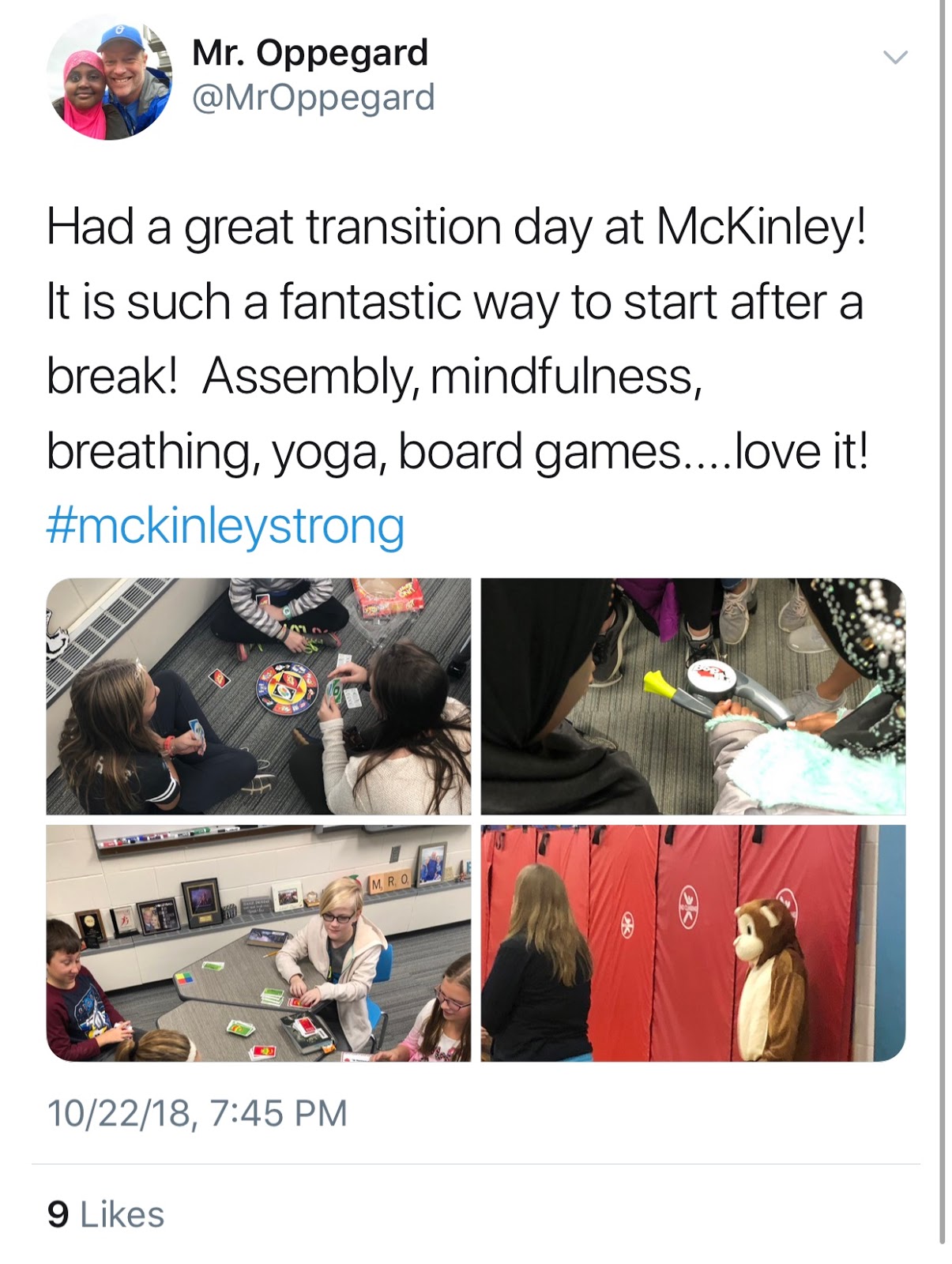
October 22nd is our first "transition day" at McKinley.  For our new staff, we engage in transition days after long breaks from school.  The goal is to reunite, re-engage, regulate, and re-establish community on these days.  We have found that students (and staff!) need this day to get acclimated back into school life.

We had a wonderful team design our first transition day.   More information will come out early next week on the details of the day.   We did move our McKinleyStrong Assembly that day to 8:40 (*the building calendar has been updated).

The POWER of THINK TIME:
It's been great getting around to classrooms to see the real work - learning - in action!  As we are designing and instructing lessons, please remember the power of "think time".  Students need time to process, question, and reflect on learning.   As a former classroom teacher, I remember teaching a lesson, getting to the end, and thinking - "did I even take a breath?"  Being intentional about building in think time would have helped me - and can help you and your students!  Don't forget... students need this time to process, but also need to productively struggle with their thinking and questioning.


September Office Referral Data:
Yesterday, our PBIS team met to analyze our September office referral data (see link below).  We looked at trends, as well as possible causes and solutions for the behaviors. 

On Monday, October 22, we have a Staff Power Hour where we will focus on this data.  Your team will spend some time looking at your grade level data and creating an action plan to see what supports/changes we can make to decrease the negative and increase the positive behaviors.  More information will come out on this.

When you have some time, check out the data below.  *Please note - these graphs include both major and minor behaviors.

Click here to access the data

Education MN Break - Take Some Time for YOU! 
Next Wednesday, Thursday, and Friday is our Education MN Break.   During this break, take some time to focus on YOU!  Do something that only YOU enjoy.  Do something that makes YOU happy and relaxed!  Our work is highly stressful and can wear on a person.  Take this break to enjoy YOU and reground yourself in your WHY and your PERSPECTIVE.  Below are some ideas, if you need them:


Mindfulness Tip from Annette:
As promised, here is #1 of 6 ideas for creating a mindful classroom:
If you already have some familiarity with mindfulness, you may know that establishing a regular practice is key to implementing mindfulness in your life, inside and outside your work environment. Here are some ways to bring mindfulness into your classroom and your teaching life.


1) Establish a regular practice. To create a mindful classroom, it is important to be anchored in your own mindfulness practice. Find a few moments each day to sit quietly and focus on your breath. First thing in the morning can be wonderful, but the best time is the time that works for you.

Mindful Breathing: If you’re brand new to mindful breathing, try this. Find a spot where you won’t be disturbed. Sit with feet flat on the floor, and with a relaxed upright back and head. Place your hands in your lap on on your thighs. Close your eyes or lower your gaze to a spot on the floor in front of you. Breathe regularly through your nose, paying attention to each in breath and out breath. Thoughts may arise; plans, worries, ideas, ruminations or stories. When they do, just gently let them go and return to focusing on each breath.
Additional Resources for Guided Practices
Challenge: Comment one mindful activity you tried this week.  A drawing of the comments will take place with winner receiving a prize. - Annette Warner, LICSW

Building Weekly Newsletter:
Click here to access the building weekly newsletter

McKinleyStrong Educator of the Week:
Our McKinleyStrong Educator of the Week goes to 2nd Grade Teacher, Katie Demmer!  Katie is a positive, creative educator who puts in countless hours to make sure students are getting the supports and learning they need.  Katie has a gift of keeping students engaged in their learning - and will even be silly (or stand on a table!) to keep them engaged and having fun!  Keep up the great work, Katie!


Have a great weekend, everyone!
-Justin

May 29 Update

Good morning! Another great week at McKinley! Can you believe we are down to 5 days left (including today)?  Let's make those last 5 day...